
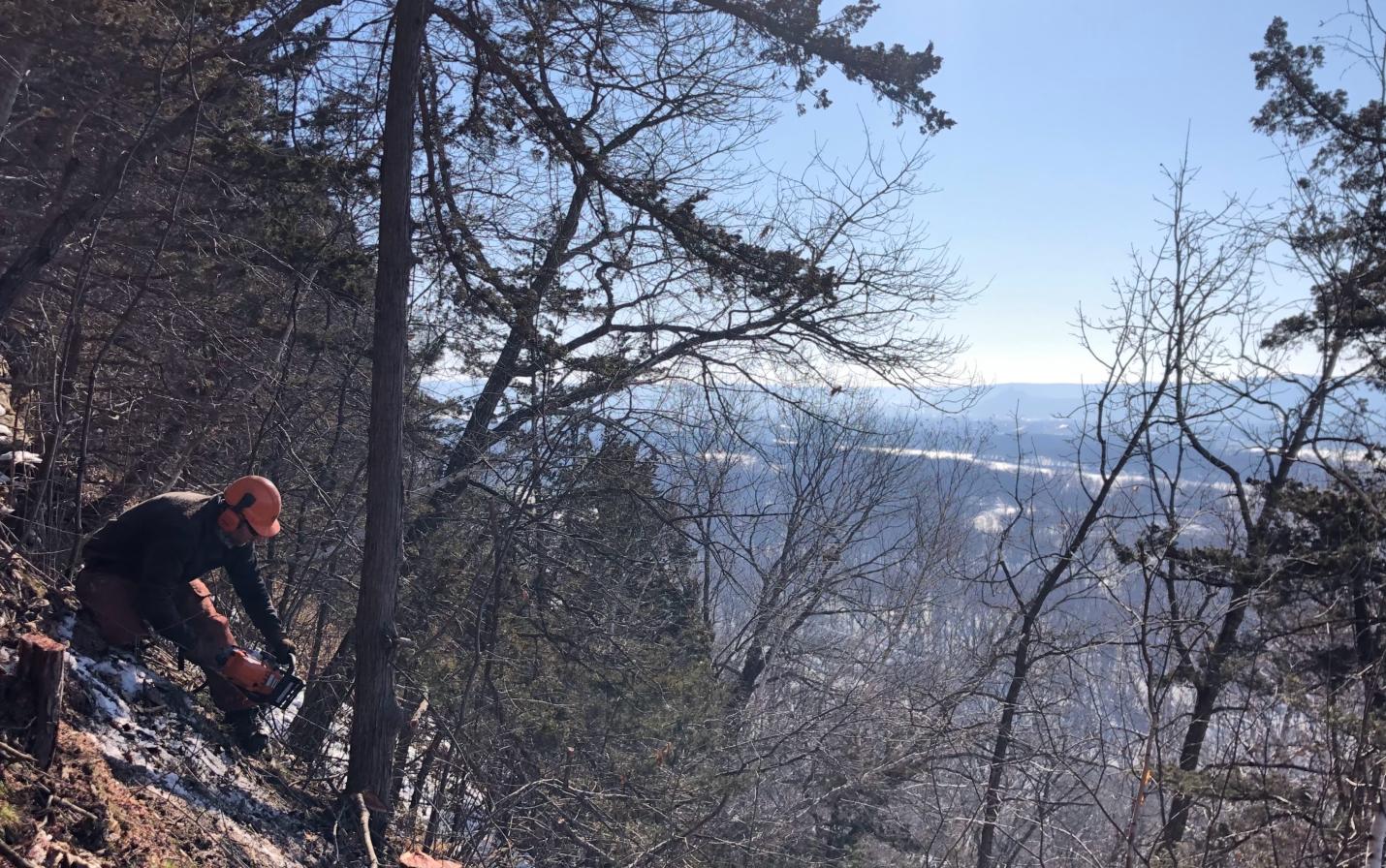
High on a bluff above the Mississippi River stands an eastern redcedar that first put down roots in the 1760s—decades before my family crossed the Atlantic in search of a new home. While my ancestors were making their way to what they called the “New World,” this tree was already growing in the wind and light of the Driftless Area. In many ways, this story—of restoration, family, and place—begins with realizing that the land here was already old, already holding memories, when my family arrived.
Eastern redcedars (Juniperus virginiana) establish rapidly in open habitat when periodic fire and seasonal grazing are absent, quickly allowing shade-tolerant trees to forest even exposed bluff faces. In our restoration work, the removal of encroaching cedars is often the first step toward restoring an untended bluff prairie. But restoring a landscape is rarely as simple as removing every undesired species—we need to look closely at the history the land holds.
Early in 2026, the land management team spent a morning clearing a cedar grove high on a bluff above the Mississippi River at Angel Bluff, a Conservancy nature preserve located east of Winona in Buffalo County. A burn is planned here this spring and we were reducing fuel just downslope from the burn break.
The grove was mostly even-aged cedars with feathery reddish bark, along with buckthorn, birch, and a small clump of switchgrass beneath their shade. But one cedar stood apart, draped over a sandstone outcrop: a split-stemmed tree with one trunk spiraling skyward and a dead stem reaching outward over the rock. Gnarled and smooth, it was clearly old.
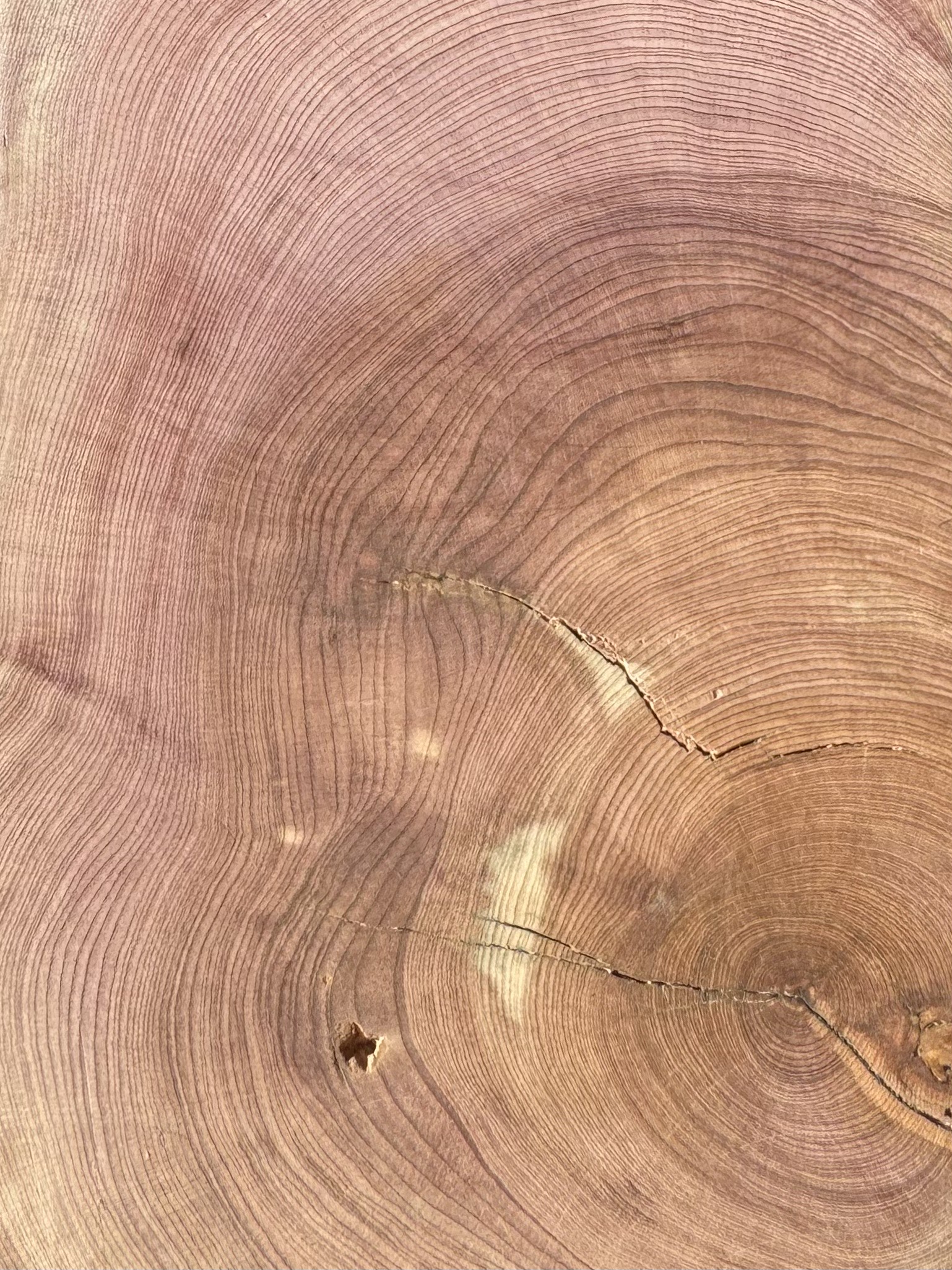
While we were cutting a neighboring cedar, the dead stem broke from its hollow base. Curious, we cut a few “cookies” to take home and finished the morning by “daylighting” the remaining living stem—clearing young cedars and brush that shaded its branches. A few days later, Restoration Coordinator Payton Lott sanded his slice and counted the dense rings. By his count, the tree is at least 261 years old, putting its first growth rings in the 1760s.
Suddenly, the timeline of this cedar stretched far beyond our morning of restoration work, reaching back into the lives and movements of people who once traveled this valley—including my own family. On August 2, 1855—within the dark latewood of the cedar’s 90th ring—a group of Swiss-German immigrants passed nearby on their way to a new home near Waumandee. Six generations back, Anna and John Conrad Ulrich brought my family to a “New World” that, according to the aged cedar, was already old.
By 1873, my family had moved to Fountain City, just five miles upriver from the old cedar. John Conrad Ulrich later wrote the memoir that passed these stories down before his death around 1890.
Since then, my family’s history has followed the Mississippi River—by foot, boat, and highway. My great-grandmother spent summers on a houseboat while her father and grandfather worked on river improvements like wing dams and shore protection. Her love of the Mississippi shaped future generations. Eventually, my grandfather returned to the area, raised a family, and bought a farmhouse east of Galesville. In February 1969, my mother was born in Winona. By then, the old cedar across the river had already lived more than 200 years.
In 1999, my grandparents placed their 77-acre property—where my mother grew up—into a conservation easement with the Conservancy, ensuring its permanent protection. Years later, when our family had to sell the land, that easement helped us hold on to something lasting: the knowledge that its pine forests, owls, orioles, “wild” apples, and lady’s-slippers will remain part of the future.
The land holds legacies of grief and joy, dispossession and connection, presence and absence. The rings of the old cedar record this complexity, alternating light and dark—each year holding both in balance.
Restoration and conservation, when done well, invite us to acknowledge the deep histories held in the land. In daylighting this old cedar, we honor a piece of living history and steward continuity rather than obscuring it.
Through this work, we take a step toward restoring our collective relationship with place—reconnecting with traditions of stewardship and recognizing the Indigenous stewards who have remained rooted here long before that cedar began reaching toward an open sky.