
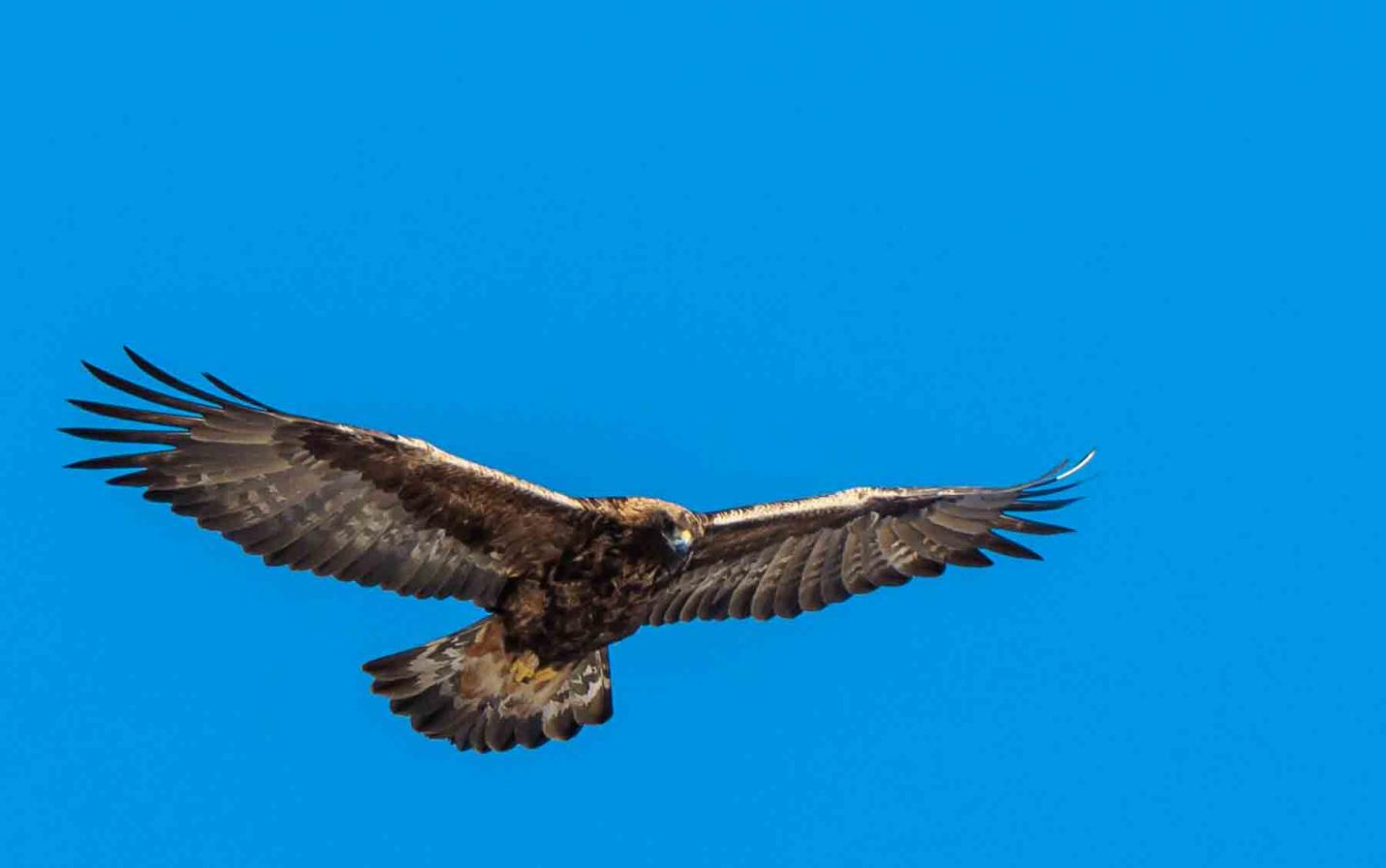
On a cold, mid-January morning, I bundled up in my coveralls, winter jacket, stocking hat, and gloves. You would have thought I was going out ice fishing, but I was out to hunt for something much more elusive: golden eagles. Thanks to the National Eagle Center, citizen scientists have been conducting an annual winter golden eagle count for over 20 years. I had never seen a golden eagle until I moved to Vernon County back in 2012, and a local birder got me connected with one of Audubon’s Christmas Bird Counts.
As it happens, the area I have been surveying since 2019 is western Vernon County. This is only one of dozens of counties that have had their focus in the Driftless area, but in recent years have expanded into adjacent areas. This data has shown that golden eagles are consistently being observed, and they are in their highest concentrations in Wisconsin’s Driftless Area. In 2026, six of the eight most active golden eagle routes were counties that include Mississippi Valley Conservancy’s service area. The area I have been surveying includes the Conservancy’s Bad Axe River Priority Area, which has over a dozen private conservation easement properties and nature preserves. These protected properties are providing habitat for a diversity of wildlife, which in the winter includes habitat for golden eagles, but also rough-legged hawks, which are both raptors that are winter migrants to our area.
The great thing about this count is that, even though the focus species is golden eagles, the count collects data on any raptors. It is an exciting morning driving around the Driftless Area, tracking your time, mileage, and birds, which can be used as data for analysis. What makes it fun is that you get to count all the red-tailed hawks, American kestrels, and bald eagles that you can observe. This past year, I also got to observe a northern harrier and a merlin, which were my highlights. Luckily, the count area is very large, and with a team of volunteers, we break up our count area into 4 areas, and sure enough, for the third year in a row, our count area has observed golden eagles. As I drove around, I now know the names and locations of the Conservancy’s protected properties, finding a diversity of raptor species along several branches of the Bad Axe River. Notably, this year our count area had the second highest most active routes for American kestrels and red-tailed hawks, and one of six merlins.
I look forward to the winter golden eagle count and plan for it as an annual activity. It is a wonderful way to spend a winter morning and participate in a citizen science effort. To me, it also demonstrates the significance of the Conservancy’s protected properties. With over 27,000 acres of land conserved in nearly 30 years, the growth and protection of the region’s land and habitat have grown, similarly to the golden eagle populations. Protecting a variety of ecosystems throughout the nine-county area ensures habitat for a diverse array of species, including winter migrants like golden eagles. From trout streams to farmland and forest land, it all provides habitat and the Conservancy’s protected properties ensure these habitats are protected forever.